


In May, my wife and I were back in Portugal, again north of Porto. We really like it there. It is not quite as touristy as Lisbon and we love Matosinhos, because as is well known, you can eat the best fish in Portugal there.
I have been retired since the beginning of January, but I still often feel the itch to do something for the shop. I prefer to be active as a wine scout. This happens automatically anyway. I just cannot stop.With Maître Philippe & Filles, we are real pioneers in Berlin when it comes to “wines from Portugal,” especially when it comes to still-unknown but very talented winemakers. For years, we have regularly attended the off-wine fair “Simplesmente” in Porto and have tasted very many, very interesting and very good wines there. We have included some of them in our range since then. For us, visiting this event is something like a pilgrimage that we look forward to all year round. At “Simplesmente,” of course, you not only meet winemakers, but also many fellow traders with whom you can exchange ideas in a friendly way. One of them is Tiago “Glouglou” Barbosa, a Portuguese from Paris, who works with a nice selection of interesting winemakers. This time we received a real insider tip from Tiago.
You really have to be crazy and brave to make wine in such a barren and inhospitable region. But that is exactly what we like so much about Portugal: It is not mainstream, and that is very good.
He recommended us to visit the “Arribas Wine Company” project in the Trás-os-Montes region (Portuguese for “behind the mountains”) in the northeast of the country. This region lives from agriculture. Here, everything is full of figs, almonds, olives, and of course also full of vineyards. The summers are very hot and dry and the winters cold, which is very good for viticulture.
The “Arribas Wine Company” project has its leased vineyards around Bemposta. The creators are two friends, Ricardo Alves and Fred Machado, who are advancing their project with a lot of energy, physical effort, passion, and knowledge. We were welcomed very warmly on a Sunday and Ricardo drove us to the vineyards in his old off-road vehicle along donkey paths. The vines are already very old at 80 or even 100 years and no longer yield much. Due to the very steep and rocky terrain, no machines can be used; everything has to be done by hand. The red wines are always so-called “field blends.” As such, they are designated as a mixture of red and white grapes, as the photo shows very well. 
As is so often the case in Portugal, only local autochthonous grape varieties are used, including Tinta Gorda, Tinta Serrana, Rufete, Alvarelhão, Bastardo, Malvasia, Verdelho, Verdelho Vermelho, Bastardo Branco, Formosa, and Posto Branco. The wines are authentic and taste unique, and they also have very little alcohol. The first wine of the project in 2017 was the red Saroto, with only 11% ABV. The 2018 red Saroto has only 11.5% ABV!

By now, there is also a white version of the Saroto, which was ready to be bottled in May. The wines are not filtered and are bottled relatively late. The red Saroto 2018 was bottled in July 2019. The quantities are very limited. That is why we immediately struck out and bought a pallet with 300 bottles each of the red and white Saroto. With that, we have exhausted our annual quota. There simply is no more.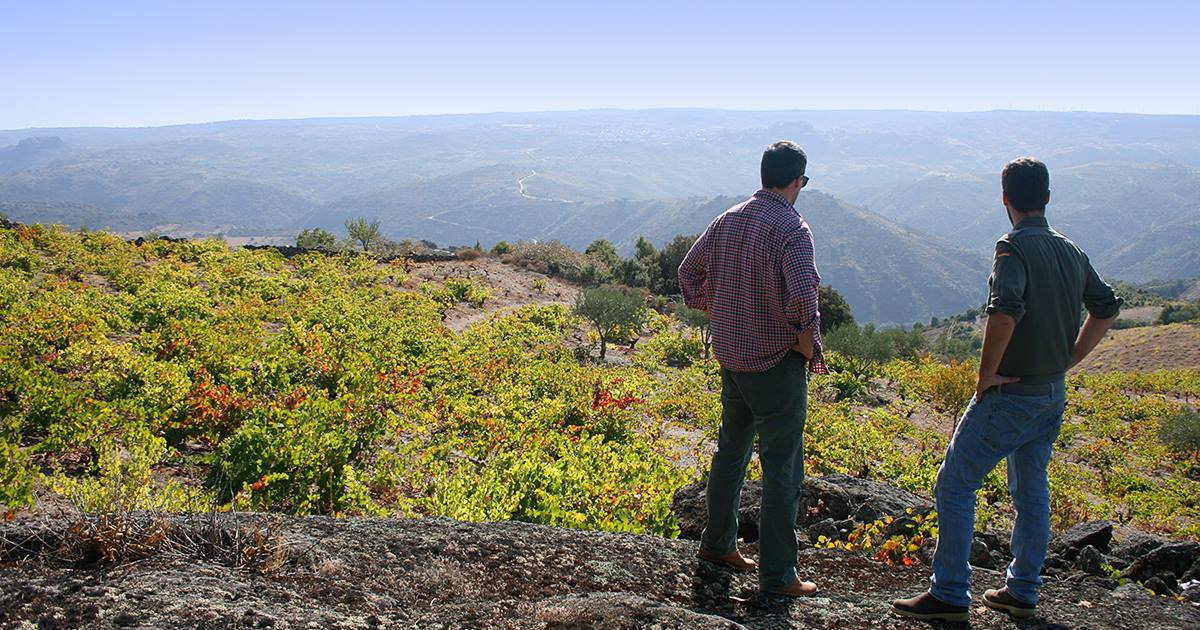
You really have to be crazy and brave to make wine in such a barren and inhospitable region. But that is exactly what we like so much about Portugal: It is not mainstream, and that is very good. The philosophy of the “Arribas Wine Company” is: “Our goal is to produce authentic, light, and pleasant wines. For this reason, we try to intervene as little as possible.” And it is being well received: The wines are already represented in many of the best restaurants in Portugal. Now it is Berlin’s turn!

