


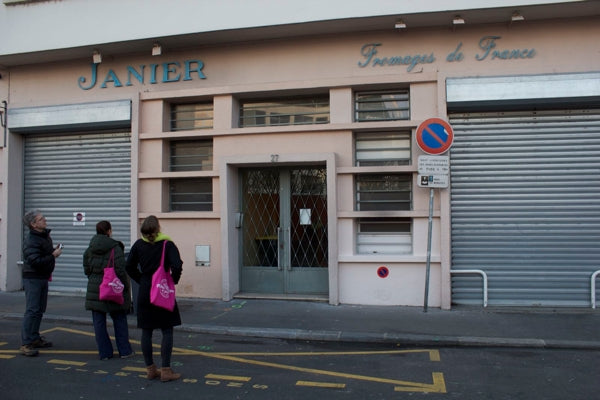
 On Thursday morning, the alarm went off at 6:30 a.m., as we still had a two-hour drive ahead of us to Lyon, where we had an 11:00 a.m. appointment with Janier. We really had to be on time, because appointments with Janier are rare, and you really shouldn't miss one!
You should know that the Janiers are among France's most important cheese affineurs. A brief explanation: an affineur does not produce the cheese themselves; they refine it. They do not have cows that they milk themselves, etc. Their job is to find farmers who produce the milk they want, have their local staff collect it, and have it processed immediately before the milk cools down (travailler le lait chaud - working the warm milk is what it's called). The cheese must take its rough shape in the region where it is produced; the Janiers have caves d'affinages (aging cellars) in many regions of France. Only then is it brought to Lyon, where it is affiné (=refined), i.e., brought to perfect maturity.
In 2000, they were awarded Meilleur Ouvrier de France (Best Craftsman in Their Trade), and now in July 2010, the Janiers were awarded the "Entreprise du Patrimoine Vivant" label by the French Ministry of Economy, making them the first cheese affineur company to receive it. This award is only given to companies that exceptionally practice, preserve, and pass on their traditional craftsmanship and knowledge.
So we sped down the highway, and this time we were even prepared to pay tolls, which we normally avoid...
Lyon is the country's third-largest city, the Autoroute du Soleil runs through the city (that is THE highway from north to south, one of France's busiest roads), and it is a confusing and opaque network of roads, underpasses, and overpasses... without the GPS we would have been lost! But we arrived on time at 11:00 a.m.
We were received warmly and cordially by Christian Janier. He must have seen our plight, the hardships we had endured in Lyonnais traffic, because he first invited us for a coffee at a bistro around the corner, where he was greeted like a regular by the waitress. Christian Janier has been running the family business for several years, but his father Maurice is still actively involved.
Christian told us that his father normally does not come to the company on Thursdays, but he made an exception to receive us and meet us. We felt even more honored.
Maurice Janier received us in his office. We must mention the aura this man radiated in his office. The office is equipped with a display cabinet, an old desk, and two visitor chairs in front of it. Countless awards hang on the walls, illustrating his work and expertise. It is the absolute opposite of today's sterile and soulless offices. And in the midst of this ambiance sat Janier Senior behind his old desk and looked at us with sparkling eyes.

He welcomed us warmly and then began to tell us about the beginnings of his business relationship with maître philippe. He pulled out a thick folder, leafed through it, showed us photos, and told us some anecdotes.
Then Christian picked us up, put us in a few thick wool jackets, and took us into the aging cellars. Unfortunately, we could not take photos, as the Janiers generally do not allow it.
The Janiers work with around 800 small dairies that produce the cheese in its raw state for them. They have strict selection criteria, the quality of each cheese is constantly checked and questioned, and as soon as there are quality defects, the cheeses are sorted out and cooperation with the dairy is terminated if necessary. The Janiers have as much "work on the cheese" done on site as possible; on the one hand, this is required by the strict A.O.C. rules (Appellation d'Origine Controlé = Controlled Designation of Origin), but more importantly, it is because the Janiers believe that terroir is absolutely decisive for the later taste of the cheese. Utilizing terroir means working with products from the region, with animals, with people and their savoir-faire, utilizing the climatic conditions of the region, because that is what makes the taste of the product unmistakable. Two Comtés, produced only 5 km apart and looking completely identical, will taste unmistakably different because the terroir is different.
Christian Janier says of himself that some call him crazy; he himself would rather put it this way: he has the passion for cheese that is needed for the profession. The story with terroir continues in the Janiers' aging cellars: Cheese from a certain region is only stored on wooden boards from trees that also come from that region. We were extremely surprised to learn that there is a profession of cheese board maker! The Janiers have been working with the same man for years, who only fells the trees during a certain period of the year, lets them rest in the forest for 6 months afterward, until he cuts them to exactly a certain width and depth and lets them dry. Very important: the boards always remain untreated and are never sanded, because only then can the air circulate under the cheese through the finest grooves in the wood. The cheese boards in Messieurs Janiers' cellars are partly up to 40 years old and are still absolutely perfect.

We were explained how to check the quality of a cheese. You always use your 5 senses.
1. If the cheese has visual defects, it is sorted out. Of course, this is not about producing a perfectly standardized uniform cheese. Cheese is a natural product. But certain errors, such as cracks in the rind, etc., can affect the quality of the cheese later.
2. The hard cheese is tapped with a small hammer, this is the acoustic check. From the sound of the tapping, the affineur recognizes how the internal consistency of the cheese is, whether it has unwanted cracks inside, etc.
3. By smelling the cheese (the inside of the cheese is gouged out with a special tool for this), you also recognize the quality.
4. The texture is checked in two ways: First, the gouged-out cheese is rubbed between the fingers, so you can feel the texture, such as salt crystals in the paste, etc., so the cheese is also warmed, which is important for the tasting. Then you feel the warmed cheese on your tongue by moving it back and forth in your mouth, crushing it against the palate...
5. Although we were already at the taste test. The cheese is moved back and forth in the mouth, as if you were tasting wine, so that it really comes into contact with all the taste buds. When swallowing, further complex aromas rise through the throat and nose.
The Janiers currently have 8 cooling chambers, all have different temperatures and humidity, depending on what the cheese needs during aging. Only one cooling chamber has no moisture added, but rather moisture removed: The one where the goat cheese is stored. Goat cheese is very moist when it is young and it must dry to age. In the past, the goat cheese was dried in the fresh air - there the moisture exchange took place automatically - but this is no longer allowed by EU hygiene regulations. However, Janier still stores the goat cheese on straw mats, because this natural material has properties that metal or plastic cannot offer: If the cheese is too moist, the straw removes moisture from it, if the cheese should ever be too dry, the straw gives moisture back to it.
A small anecdote reflects the philosophy, passion for cheese, but also the uncompromising attitude towards quality of the House of Janier very well: Christian Janier absolutely wanted to include a mozzarella in the range. It took 3 whole years until, after countless trips through Italy, he found a mozzarella that met his standards. This really sensationally good-tasting mozzarella is, of course, also available for purchase at maître philippe...
After the tour, the Janiers invited us to lunch at the restaurant "La Fourvière", which is located directly next to the basilica high up on a hill in Lyon and from whose panoramic terrace you have an incredible view over Lyon. We could even see the Montblanc in the distance, but according to Christian Janier, that is a bad sign, because then it almost always rains the next day. Well, that is exactly what happened.
We had a typical Lyonnais menu with Andouillettes (tripe sausage) for the first course and Quenelles de brochet (pike dumplings) for the main course. Both were delicious!
The Janiers are wonderful hosts: They are warm, very funny, and truly interesting and genuine people who despite their success have remained very down-to-earth. When we thanked them enthusiastically for the great day and for taking so much time for us, they waved it off and said that it was completely normal for them - and they really meant it.

