


All the experts agree: good wines from Portugal have long been among the best in the world. This is partly because Portugal is home to around 200 indigenous (if not more!) grape varieties – a huge stroke of luck! A lot is happening, especially in the Douro Valley!

Nowadays, people are talking about a veritable “Douro Revolution,” because unlike not so long ago, when only grapes for Port wine were grown there, today’s new winemakers are focusing on improving the quality of their own local wines. The new generation now at the helm, with whom we are delighted to work, is between 30 and 40 years old and thinks very differently. The French vines that once grew in many places were pulled out and replaced with indigenous Portuguese vines. A perfect example is our bestseller from the Alentejo: the Alento wines by Luis Louro at Adega do Monte Branco in Estremoz.
So, we were fortunately able to prove we had a good instinct even when we first bought his wines, because as wine experts, we play the role of scouts in a way: we taste, reject, taste, discover ... and only when we are truly convinced will you be able to get the corresponding bottles from us.

A truly outstanding new discovery with which we only recently expanded our slowly growing Portuguese wine program is the wines of winemaker Rita Marques Ferreira from the Douro Valley. Rita’s family has been making wine in the upper Douro for several generations. Her vineyards cover a total of around 85 hectares at an average altitude of 500m above sea level.
The vineyards are tended without the use of chemicals. All work is still done by hand. Rita, who learned her craft in Bordeaux and then worked as a “Flying Winemaker” in New Zealand and South Africa, sells part of her harvest to other wineries. For her own wines, she only keeps the very best and produces fine and elegant wines with plenty of freshness and minerality. Everything is carefully considered, because Rita has a concept (hence the name: Conceito). Through this concept, Rita reflects the freshness, beauty, and balance of her country. That is what she believes in. And so do we.
Rita’s concept: "The foundation of my work is our understanding of wine – how we think about and make it – the respect and love for our region, our home, and the inspiration drawn from the region’s history – our history. Since the 18th century, this wonderful landscape was exclusively monopolized for the production of grapes for Port wine, and the enormous potential of the eastern Douro was only recently truly recognized. Several factors came together: first, global demand for Port wine declined; second, the entire Douro region was opened up by the railway and the development of roads. The third and probably most important factor is the change in thinking among the winemakers themselves, the “Douro Revolution,” which promotes the production of very good red wines. This also allows the region to be seen as a mosaic of many small terroirs, each with its own very specific characteristics: for example, the vineyards are generally tended by hand, and each is distinguished by its own unique microclimate. We are only at the beginning of a long journey, but we are really eager to get started, with heart and soul. The best wine journalists were not mistaken, and the wines are already receiving scores of often over 90 points. Many renowned winemakers from other countries have also already invested in the area. There is an Eldorado, gold-rush atmosphere in the air that is infecting us all."
I had already heard a lot about Rita – her reputation as a top winemaker preceded her (Wine Spectator regularly gave her 93/94 points …). However, I had not met her personally until then. To change this, my wife and I recently flew to Lisbon especially for a wine party. I finally wanted to meet her in person, introduce myself, and convince her to sell us her wines. Our friend and supplier Luis Louro made the introduction. That certainly helped us win her over. And the fact that I speak a fair amount of Portuguese :)

And now for the wines:
Rita produces a beautiful range of wines. We have chosen the following six wines: the entry-level “Contraste” wines in red and white, the more refined “Conceito” wines, also in red and white, and two Port wines – a Tawny and an LBV.
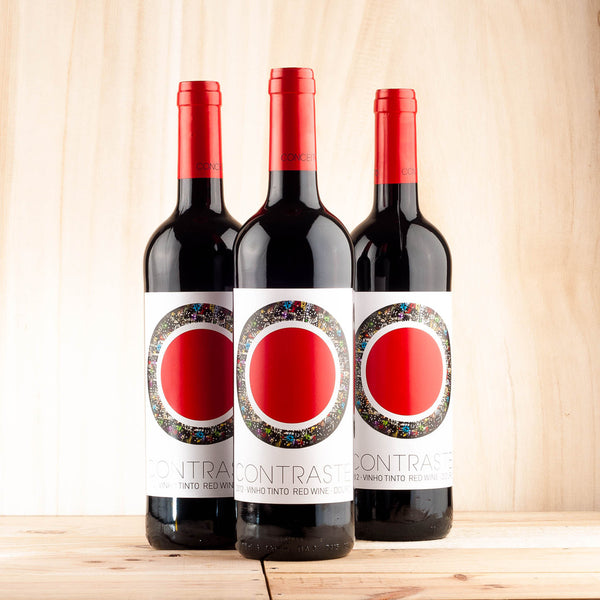
The Contraste Tinto 2012 is a deep dark red with beautiful violet reflections and leaves heavy tears on the side of the glass. Immediately after opening, notes of cassis and blackberry appear, which after a while are complemented by spice notes (bay leaf and pepper). The more you drink, the more aromas emerge, and it quickly becomes clear that you have found a real gem. The Contraste tinto 2012 impresses with power, finesse, and elegance, and at a very fair price.
It pairs very well with cheeses such as Epoisses, Brie, and Taleggio, as well as salami and grilled meat, and above all fatty fish such as sardines, mackerel, and tuna.
The Contraste tinto 2012 is made from Touriga Nacional, Touriga Franca, Tinta Roriz, and Sousão grapes.
The vines grow on the Quinta do Cabido and Quinta Chão do Pereiro on slate soil and are already quite old at around 40 years.
The grapes ripened very slowly, as winter, spring, and autumn were all very dry this year, and there was no rain during the harvest either. As a result, the yield was very low, but the grapes were healthy and of absolutely top quality.
As with almost all of the Douro, the harvest is done by hand. The harvested grapes are transported in small 20kg boxes to prevent damage, then sorted by hand, destemmed, and gently pressed. Fermentation takes place in stainless steel tanks at a controlled temperature over several days. After several gentle pump-overs, a one-week quiet final maceration follows. Malolactic fermentation takes place in tanks. This is followed by 18 months of aging – 70% in used French barriques and 30% in stainless steel tanks.
- Price: Bottle (75 cl) €9.95, case (6 bottles) €55.00
- Alcohol: 13.5% ABV.
- Acidity: 5.2 g/l
- pH: 3.63
- Residual sugar: 0.3 g/l
- Rating: eParker: 90 pts, Revista de vinhos: 16.5/20

The Contraste Branco 2014 surprises with intense, tropical, almost exotic notes of lime and lychee on the nose, which are found again in the mouth. The wine exudes a freshness, minerality, and elegance that one would not expect from Southern Europe. A wine made for Riesling lovers.
It classically pairs with fish, seafood, sushi … but also risotto or simply on its own as an aperitif.
The Contraste branco 2014 is made from Rabigato, Códega do Larinho, Códega, and Arinto grapes. The vines grow on a small granite plateau at 600m above sea level, about 15 km west of Foz Côa.
Winter and spring were very wet and were followed by a dry but not too hot summer. During the harvest in mid-September, heavy rains occurred, so the harvest had to be stopped. As a result, the yield was unfortunately very low. However, the grapes that had already made it to the cellar were in perfect and healthy condition.
After the harvest, the grapes are immediately cooled and gently pneumatically pressed without being destemmed. Filtration is done only by cold, followed by 6 months of aging, 30% in new and used French barriques and 70% in stainless steel tanks with regular batonnage until bottling in March 2015.
- Price: Bottle (75 cl) €9.95, case (6 bottles) €55.00
- Alcohol: 13% ABV.
- Acidity: 6.41 g/l
- pH: 3.02
- Residual sugar: 0.8 g/l
- Rating: likely 92 pts by Parker
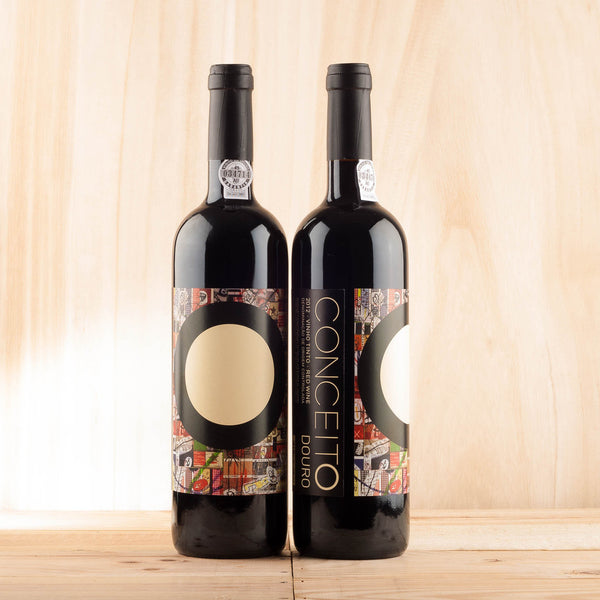
The Conceito Tinto 2012 is a very dark red, almost black, and immediately after opening, aromas of Madagascar pepper, licorice, and wild blackberries rise to the nose. It is a classic “Super Douro wine”: elegant despite its full body, and refreshing. The aromas of the bouquet are also found in the mouth, and you immediately feel the fine ripe tannins. This wine is reminiscent of expensive Pomerol wines and has at least 10 years of potential ahead of it.
It pairs with all game dishes and also duck.
The Conceito Tinto 2012 is made from more than 20 different traditional Douro grapes (that is more than in Châteauneuf-du-Pâpe!), including Touriga Franca, Touriga Nacional, Tinta Roriz, Tinta Amarela, Rufete, and Sousão.
The vines grow on slate soil at Quinta do Cabido in a natural amphitheater with a southern orientation. At around 80 years old, the vines are very old. Their yield is low, but of excellent quality.
Due to the very dry winter, spring, and summer, the berries ripened very slowly, but perfectly. Fortunately, the weather played along during the harvest, so there were no losses to report.
The harvest is done by hand. The grapes are transported in small 20kg baskets and carefully sorted – both at the vine and in the cellar. The grapes are then partially destemmed and pressed, and pumped into stainless steel tanks. Fermentation takes place at a controlled temperature, with gentle pump-overs and a subsequent final one-week rest. Malolactic fermentation takes place in the tank.
Aging lasts 20 months and takes place 50% in new French barriques and 50% in used French barriques of 2 years.
- Price: Bottle (75 cl) €29.50, case (6 bottles) €165.00
- Alcohol: 14% ABV.
- Acidity: 5.2 g/l
- pH: 3.54
- Residual sugar: 0.6 g/l
- Rating: eParker: 93 pts, Revista de vinhos: 17.5/20
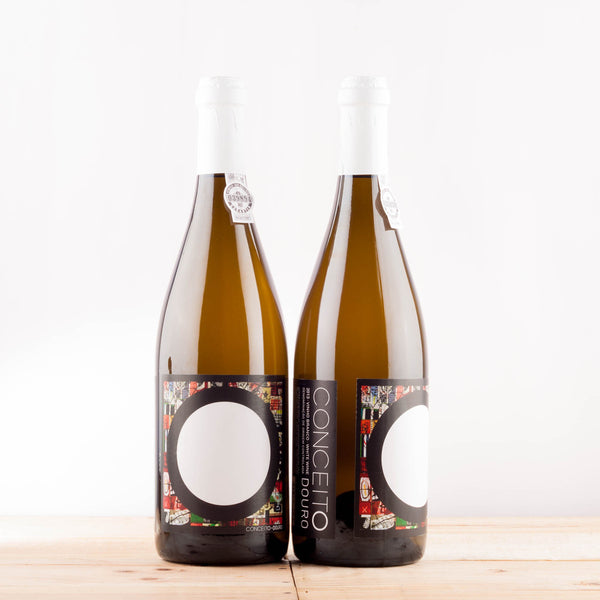
The Conceito Branco 2013 astonished us with its pronounced finesse and minerality. Already with the first sip, we were reminded of great Chablis Grand Crus or even some Puligny-Montrachet. Yet it is also completely different, and you can clearly tell its mountainous origin: it is as wild and untamed as a crystal mountain stream. At the same time, it has a lot of body and a very long finish. Its salty-mineral side is also very special, which is coming out more and more in recent vintages. Its natural acidity gives it lightness and elegance.
One of the best white wines I have ever drunk from Southern Europe – a wine with a lot of potential ahead of it!
It pairs with fine fish and seafood such as pike-perch, sea bream, sea bass, langoustines, lobster, and scallops, as well as risotto, veal, Bresse chicken …
The Conceito Branco 2013 is made from around 10 different traditional Douro grapes, including Rabigato, Códega do Larinho, Códega, Gouveio, Donzelinho Branco, Folgazão, and Arinto.
The vineyards are located on extremely hard granite soils on a narrow little plateau, 600m above sea level in Freixo de Numão, 15 km west of Foz Côa. The vines are very, very old, many dating back even before the Phylloxera catastrophe.
While winter and spring were very rainy, temperatures rose sharply from June 21 and remained so until early September. Therefore, they had to hurry to harvest as much as possible, but then all the grapes that reached the cellar were in very healthy condition.
The harvest is done by hand and the grapes are transported in small 20kg baskets. They are immediately cooled and gently pneumatically pressed without being destemmed. Filtration is done only by cold, followed by fermentation in French barriques at a controlled temperature with regular batonnage until bottling in June 2014.
Aging lasts 10 months and takes place in used barriques with regular batonnage.
- Price: Bottle (75 cl) €29.50, case (6 bottles) €165.00
- Alcohol: 13% ABV.
- Acidity: 6.6 g/l
- pH: 3.02
- Residual sugar: 1.1 g/l
- Rating: eParker: 94 pts, Revista de vinhos: 17.5/20
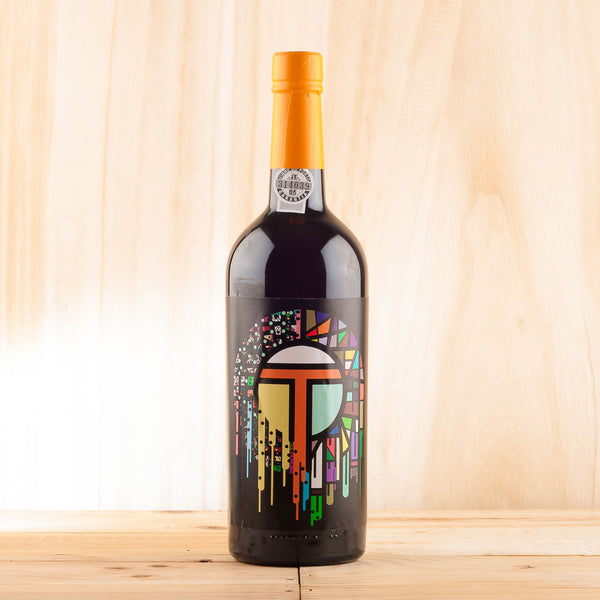
The Tawny Port 10 years exudes an aroma that immediately makes you feel like you are back in your childhood: caramelized walnuts mix with cotton candy and dried fruit. Earthy notes are added, as well as aromas of trail mix and ripe figs, which later combine in the taste into a perfect symbiosis. The subtle but lasting sweetness in the finish makes this Port a perfect companion for cheese or full-bodied desserts.
- Grape varieties: a blend of traditional Douro grape varieties, including Touriga Nacional, Touriga Franca, Tinta Roriz, Tinto Cão, Tinta Barroca
- Alcohol content: 20% ABV.
- Acidity: 3 g/l
- pH value: 3.5
- Residual sugar: 99 g/l
- Region: Porto D.O.
- Vintage: Blend of different vintages
- Vinification: traditional Port wine vinification, no destemming and treading by foot in traditional granite lagares. Pre-fermentation maceration for 2 days, then fermentation for 3 days. Addition of grape alcohol, short maceration and subsequent 10-year barrel aging.

The Port LBV 2009 is from purple to black, the nose is intoxicating and exuberantly fruity. You can literally smell overripe wild blackberries and also fine black pepper (like Kappad). A pinch of violet joins it. It is opulent with intense fruitiness, incredibly soft and silky. The finish is long. Once opened, you should drink this Port wine within 2 - 3 days, but that should not be difficult at all. Because once you start, you won't want to stop … :)
- Grape varieties: a blend of traditional Douro grape varieties, including Touriga Nacional, Touriga Franca, Tinta Roriz, Tinto Cão, Tinta Barroca
- Alcohol content: 19.5% ABV.
- Acidity: 3.2 g/l
- pH value: 3.64
- Residual sugar: 97 g/l
- Region: Porto D.O.
- Vintage: 2009
- Vinification: traditional Port wine vinification, no destemming and treading by foot in traditional granite lagares. Pre-fermentation maceration for 2 days, then fermentation for 3 days. Addition of grape alcohol, short maceration and subsequent bottling in barrels. Bottled in June 2013.

